

Dates: 3rd July 2026, 7th July 2026 & 8th July 2026
Time: 10:30 a.m. – 4:00 p.m. (3rd & 7th July) | 10:30 a.m. – 4:30 p.m. (8th July)
Venue: G-302
Participants: 21 Faculty Members, PG School of Business
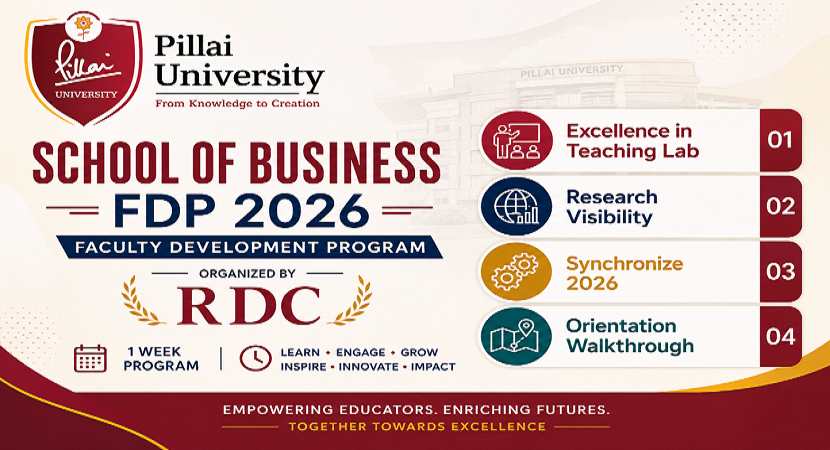
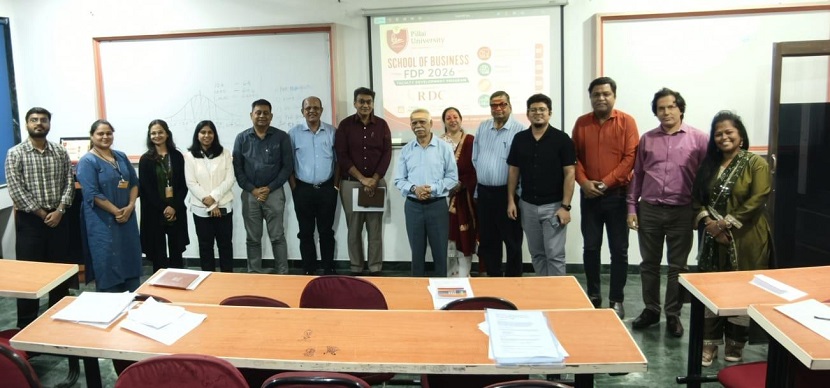
The PG School of Business successfully organized a three-day Faculty Development Programme (FDP) titled “Excellence in Teaching Lab” on 3rd, 7th, and 8th July 2026. The programme was attended by 21 Faculty Members and was chaired by Dr. R. Chandran, who served as the resource person for all three sessions.
The primary objective of the FDP was to enhance teaching effectiveness by equipping faculty members with innovative pedagogical approaches and learner-centric teaching practices. The sessions focused on improving classroom engagement, designing meaningful assessments, and creating impactful learning experiences for students.
Dr. Chandran commenced the programme by emphasizing the evolving role of educators in higher education. He highlighted that effective teaching is built on the three fundamental pillars—Assignment, Assessment, and Engagement. He shared practical strategies and guiding principles that faculty members can adopt to make their teaching more interactive, outcome-oriented, and student-centric. A significant component of the FDP was the faculty teaching demonstration. Each participant was required to present a teaching session showcasing their preferred pedagogy and classroom delivery techniques. Faculty members demonstrated a wide range of innovative teaching-learning methodologies, including:
- Role Play
- Case Study Method
- Simulations
- Quiz-Based Learning
- Group Discussions
- Activity-Based Learning
- Problem-Based Learning
- Storytelling
- Collaborative Learning
- Technology-Enabled Teaching
Following every presentation, Dr. Chandran provided detailed and constructive feedback on the content delivery, student engagement strategies, assessment methods, communication skills, and classroom management techniques. In addition, peer faculty members actively participated by sharing suggestions, appreciating innovative ideas, and providing constructive reviews. This collaborative review process enabled participants to learn from one another and reflect on their own teaching practices.
The sessions were highly interactive, encouraging open discussions, knowledge sharing, and collaborative learning among the participants. Faculty members gained valuable insights into designing engaging lesson plans, integrating innovative pedagogies, and aligning teaching methods with learning outcomes.
Overall, the Excellence in Teaching Lab proved to be a highly enriching and insightful Faculty Development Programme. It strengthened the teaching competencies of the faculty, fostered a culture of peer learning and continuous improvement, and reinforced the institution’s commitment to academic excellence and quality teaching.
