Date: 10th September 2025
Venue: Auditorium
Time: 2:30 PM- 3:15 PM
Participants : 230
The session commenced with a thought-provoking question: “What is AI? Will AI replace humans, or is it truly capable of doing so?” This set the stage for an in-depth exploration of Artificial Intelligence, its capabilities, and its limitations.
An overview of the AI model and its functioning was presented, providing a clear understanding of how AI systems operate. Owing to the technical nature of the subject, no interactive activities were included, allowing the session to focus entirely on the conceptual and practical aspects of AI.
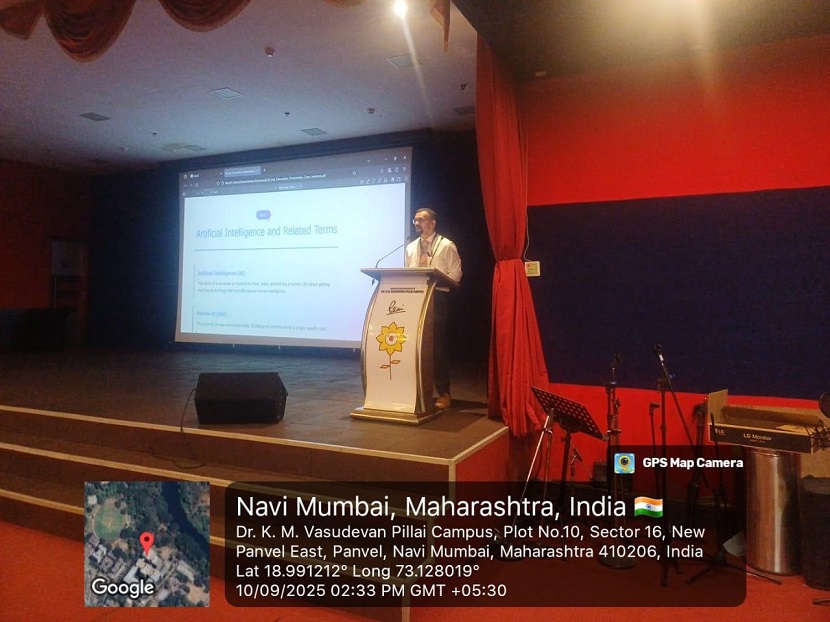
Participants were introduced to the types of AI systems, specifically Artificial Narrow Intelligence (ANI) and Artificial General Intelligence (AGI). The discussion traced the evolution of AI, beginning with early rule-based if–then systems and progressing to the advanced multimodal large language models (LLMs) that exist today.
The session also covered the concept of “Coding for All,” emphasizing that basic coding is now accessible to everyone with the assistance of AI-powered tools such as Microsoft Power Platform, Make, N8N, and Zapier. This highlighted how AI is simplifying technical tasks and enabling broader participation in coding and automation.
Further, the AI Framework was explained, underscoring the indispensable role of human involvement. It was emphasized that while AI can perform complex computations, it lacks emotions, moral judgment, and ethical reasoning. Tasks such as hiring personnel, making decisions based on empathy, or addressing moral dilemmas require human oversight. The session also stressed that any mistake made by an AI system ultimately holds its human creator accountable, as humans are the feeders and trainers of AI models.
The discussion extended to the impact of AI on supply chains and operations, illustrating how AI integration streamlines workflows and increases efficiency. By automating routine tasks, AI enables professionals to focus on more strategic responsibilities, enhancing productivity while saving time and effort.